What Should I Know Before Visiting a Builder's Sales Office in Morgan Hill?
A model home can make a new construction purchase feel simple.
You walk in.
The home is clean.
The finishes are polished.
The sales representative is friendly.
The floor plan looks easy to imagine.
Then you hear about available homesites, current incentives, preferred lenders, and quick move-in opportunities.
It can feel like everything is moving in the right direction.
But before you visit a builder's sales office in Morgan Hill, you should know what questions to ask, who represents whom, how builder registration works, what is included in the base price, and how HOA dues, taxes, incentives, timelines, inspections, and closing costs affect the real decision.
The goal is not to avoid the sales office.
The goal is to walk in prepared.
DeVonna Meyer is a luxury real estate agent in Morgan Hill, CA, helping first-time buyers understand new construction, builder sales offices, registration rules, incentives, preferred lenders, inspections, contracts, monthly payments, and long-term purchase decisions with clarity, care, and a steady plan. Based in Morgan Hill since 1988 and licensed since 2006, DeVonna helps buyers look past the model home and understand the complete purchase before making one of life's biggest financial decisions.
Quick Answer
Before visiting a builder's sales office in Morgan Hill, first-time buyers should know:
The builder's sales team generally works on the builder's side of the transaction.
Some builders require your agent to be registered or present on the first visit.
The model home may include upgrades that are not part of the base price.
Builder incentives may be tied to a preferred lender, specific home, or deadline.
HOA dues, special taxes, solar structure, insurance, and post-closing costs can change the real monthly payment.
Construction timelines are estimates until you understand the contract.
New homes can still need independent inspections.
The best first visit is not a shopping trip.
It is a fact-finding visit. Your attached research makes that same point: the first visit should be about gathering hard information, not reacting to the sales environment.
The Builder Sales Office Check
Before you walk in, ask yourself:
Do I want my own agent involved?
Have I confirmed the builder's registration policy?
Do I understand my pre-approval and comfortable budget?
Do I know what I should not share too early?
Have I prepared questions about base price, upgrades, incentives, HOA dues, taxes, solar, insurance, and timelines?
Am I ready to ask what is standard and what costs extra?
Will I avoid signing anything until I understand it?
That preparation can protect the buyer from pressure, confusion, and rushed decisions.
Table of Contents
- Start with representation
- Why the first visit can matter
- Bring your pre-approval, but protect your budget
- The model home is not always the base home
- Ask about incentives and preferred lenders
- HOA dues, special taxes, and public reports
- Timelines, phases, and construction delays
- Inspections and warranties
- Morgan Hill communities to compare carefully
- What not to do during the first visit
- Red flags at the sales office
- What to do after the visit
- Real Example
- What People Get Wrong
- Related Morgan Hill Buyer Resources
- FAQ
- Bottom Line
- Strategizing Your Next Chapter
- About DeVonna Meyer
- Contact DeVonna Meyer
Start With Representation
The first thing to understand is simple:
The builder is the seller.
The on-site sales representative may be helpful, professional, and knowledgeable.
But that does not automatically mean that person represents you.
California's Department of Real Estate explains that, effective January 1, 2025, a buyer's agent must have a signed buyer-broker representation agreement with a buyer client as soon as practicable, but no later than when the buyer executes an offer. The agreement must address compensation, services, when compensation is due, and the expiration date. The DRE also notes that a buyer may proceed without representation or consider dual agency where allowed.
That means you are not legally required to hire your own agent.
But if you want independent representation, clarify that before visiting.
The safest question to ask before you go is:
Who is looking at this purchase entirely from my side?
Why the First Visit Can Matter
Many builders have broker-registration policies.
Those policies can affect whether your own agent can be recognized later.
KB Home says broker co-op payment requires the agent to comply with KB's registration agreement, accompany the client on the first visit, confirm a written buyer-broker agreement, and submit a signed buyer-broker agreement that predates the purchase agreement.
Toll Brothers says an agent must complete electronic registration at the time of the client's first visit to a specific community to be eligible for its co-op program.
City Ventures says the broker or agent must accompany and register clients with the on-site sales team on the first visit to be eligible for any broker referral fee.
Policies vary by builder and community.
But the practical lesson is the same.
If you want your own agent, speak with that agent before you visit the sales office.
Do not assume you can tour alone, give your information to the builder, and add your agent later.
Sometimes a builder may allow it.
Sometimes they may not.
Ask first.
Bring Your Pre-Approval, but Protect Your Budget
A builder will usually want to know that you can purchase.
That is reasonable.
Bring your pre-approval or be ready to discuss financing.
But do not start by sharing the very top of your price range.
There is a difference between:
"I am pre-approved and ready to understand the options."
And:
"This is the absolute most I can spend."
A first-time buyer should know the comfortable number before the visit.
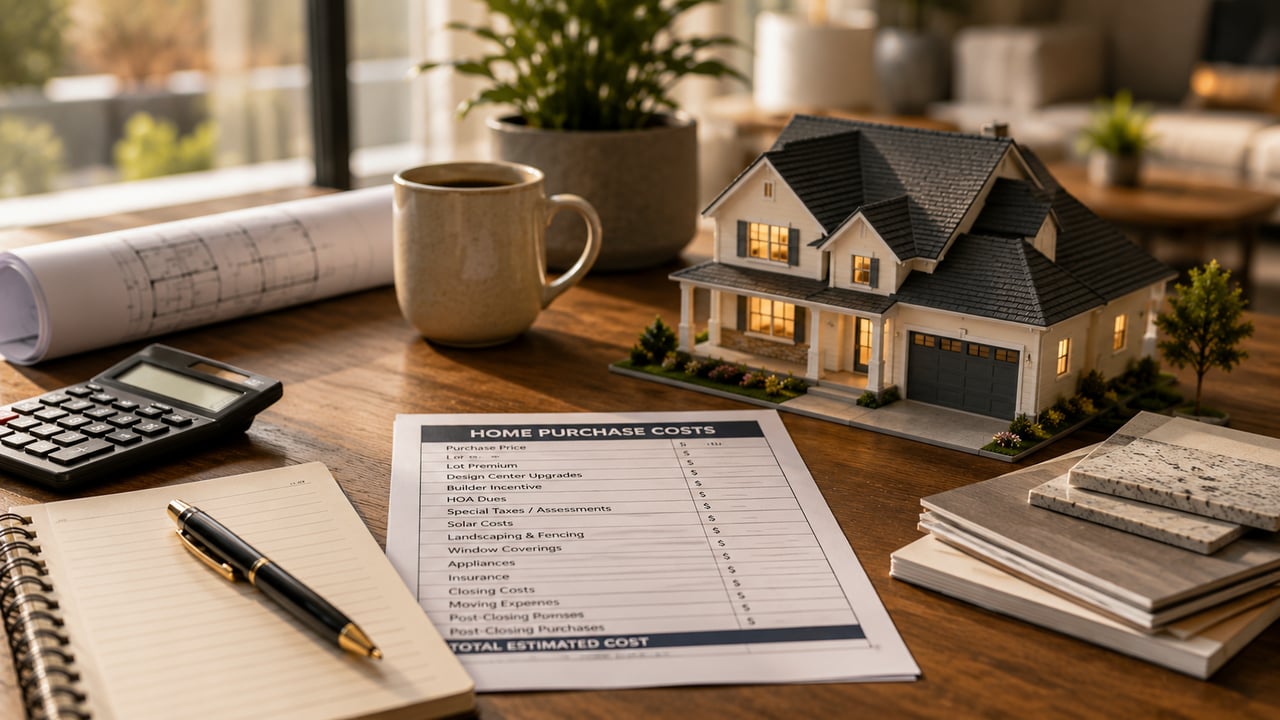
That number should include:
Principal and interest.
Property taxes.
HOA dues.
Insurance.
Solar costs, when applicable.
Special taxes or assessments.
Post-closing expenses.
A pre-approval tells the builder you are serious.
Your comfortable budget tells you when to slow down.
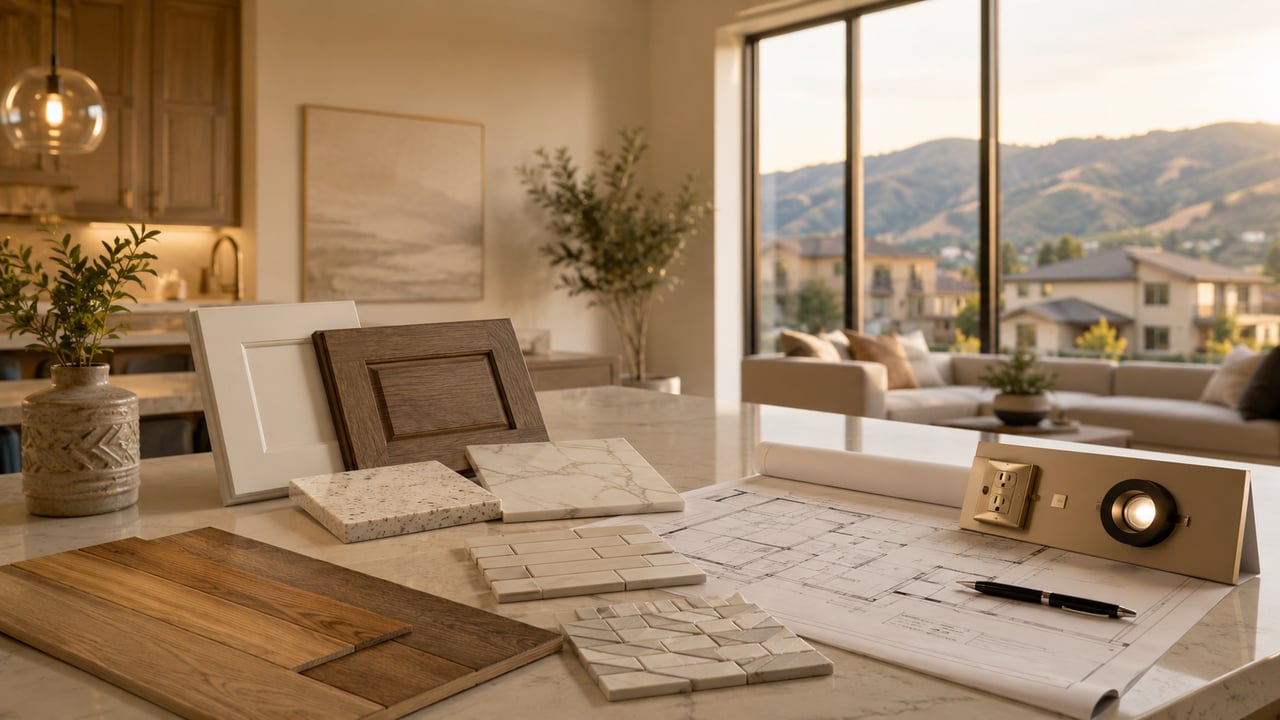
The Model Home Is Not Always the Base Home
The model home is designed to make a strong impression.
That does not mean everything you see is included.
Ask directly:
What is standard?
What is upgraded?
What does this model cost as shown?
Can I see the standard features list?
Are window coverings included?
Which appliances are included?
Is backyard landscaping included?
Are patios, fencing, lighting, and smart-home features standard or optional?
At Huntington, DeNova's FAQ says buyers may need additional deposits for builder options and upgrades, countertop selections, flooring, and window coverings at the design center. The same FAQ identifies Huntington as a community with homes from about 1,415 to 1,800 square feet.
That is a good reminder.
The advertised starting price may not be the finished home you pictured.
Ask for the details in writing.
Ask About Incentives and Preferred Lenders
Builder incentives can help.
They may include:
Closing-cost credits.
Rate buydowns.
Design credits.
Upgrade allowances.
Price reductions.
Appliance packages.
Special quick move-in offers.
But incentives often have conditions.
Ask:
What incentives are available today?
Which homes qualify?
When does the offer expire?
Is the incentive tied to your preferred lender?
Can I use my own lender?
What do I lose if I use my own lender?
Is the buydown temporary or permanent?
What will my payment be in year three?
Can I get the full terms in writing?
The Consumer Financial Protection Bureau recommends comparing Loan Estimates so buyers can review loan amount, interest rate, projected payments, mortgage insurance, closing costs, lender credits, cash to close, and the five-year cost of borrowing.
A builder incentive should make a good decision easier.
It should not make an unclear decision feel safe.
HOA Dues, Special Taxes, and Public Reports
Many Morgan Hill new construction communities involve common areas, amenities, shared maintenance, or condominium ownership structures.
That means HOA dues may be part of the monthly payment.
Ask:
What are the current HOA dues?
What do they cover?
Can dues change?
Is there a reserve study?
What insurance does the HOA carry?
What must I insure separately?
Are there rental restrictions?
Are there parking rules?
Are there limits on exterior changes?
Also ask about special taxes, direct levies, or assessments.
Do not assume.
Verify the specific property.
For new subdivisions and common interest developments, the California Department of Real Estate says public reports contain important information, including CC&Rs, HOA costs and assessments, common-area details, and other material disclosures. The DRE also says a subdivider must provide the public report before the buyer becomes obligated to purchase the lot or unit.
Read it before you commit.
Timelines, Phases, and Construction Delays
A new home may be complete.
It may be nearly complete.
It may be months away.
It may be part of a future phase.
Ask:
What phase is this community in?
How many homes remain?
Is this a quick move-in home or a to-be-built home?
What is the estimated completion date?
Is that date guaranteed?
What happens if the home is delayed?
What happens to my rate lock if closing moves?
Can I cancel after a certain delay?
What does the contract say?
This matters for first-time buyers who are coordinating rent, a lease ending, a move from another city, a job change, or school timing.
A floor plan can be perfect.
A timeline can still create stress.
Inspections and Warranties
New does not mean flawless.
A new construction home can still have issues with workmanship, drainage, windows, electrical, plumbing, insulation, finishes, or punch-list items.
Ask:
Can I bring my own inspector?
Can I inspect before drywall?
Can I inspect before closing?
How are inspection items handled?
What happens if something is incomplete at the final walkthrough?
What warranty documents can I review before signing?
What is covered?
What is not covered?
What could void coverage?
A city inspection and a builder orientation are not the same as an independent buyer inspection.
New construction still deserves due diligence.
Morgan Hill Communities to Compare Carefully
The examples below are not recommendations. They are reminders to study each community, plan, phase, and cost structure carefully.
Crosswinds is planned for 269 homes, including single-family homes, duets, and condominiums, with 40 BMR units and community open space.
Manzanita Park is a 67-unit condominium project on about 5.8 acres with open space, amenities, paseos, sidewalks, and trails.
The Gates by City Ventures is a mixed-use project on 3.82 acres with 49 townhome-style condominiums and a commercial component near Monterey Road and Cochrane Road.
Huntington by DeNova is a 93-unit residential condominium development with 20 three-story buildings and two- and three-bedroom units.
The Lumberyard by Van Daele is a downtown Morgan Hill project with modern flats and townhomes near Depot Street and East Dunne Avenue.
Moonstone at Rosewood by Brookfield Residential is another Morgan Hill new-home option, with Brookfield describing it as a townhome collection in the Rosewood community.
The point is not that one community is automatically better.
The point is that each one has a different cost, location, product type, HOA structure, financing conversation, and lifestyle fit.
What Not to Do During the First Visit
On your first visit, try not to make decisions while you are still excited.
Do not sign anything you do not understand.
Do not assume the model home reflects the base price.
Do not share your absolute maximum budget too early.
Do not rely on verbal promises without written terms.
Do not assume incentives are automatically the best deal.
Do not skip asking about HOA dues, special taxes, solar, insurance, and future phases.
Do not leave without knowing what happens next.
The first visit should help you gather information.
It should not pressure you into a decision before you have compared the full picture.
Red Flags at the Sales Office
Slow down if you hear:
"This incentive ends today."
"You do not need to compare lenders."
"Everything in the model is basically included."
"You can add your agent later."
"You do not need an inspection because it is new."
"Do not worry about the HOA documents."
"We will explain the contract after you sign."
Those statements may not always mean something is wrong.
But they do mean you should ask more questions.
A good purchase can withstand careful review.
What to Do After the Visit
Do not make the final decision in the model home.
After the visit:
Debrief with your agent.
Compare base price with finished price.
Review the standard features list.
Compare the builder's lender with an outside lender.
Check HOA dues, public report, and tax information.
Ask for insurance quotes for the specific property.
Drive the area at different times of day.
Think about parking, commute, noise, sun exposure, and future phases.
Review inspection rights and warranty details.
Ask what happens if construction is delayed.
Then decide.
A calm second look often reveals more than the first visit.
Real Example
Imagine a first-time buyer visiting a Morgan Hill sales office on a Saturday.
The buyer loves the model.
The builder has a quick move-in home.
There is a closing-cost credit.
The sales representative says another buyer may be interested.
It feels urgent.
Now the buyer asks the right questions.
What is standard?
What is upgraded?
What is the HOA?
Are there special taxes?
Is the incentive tied to the preferred lender?
What is the year-three payment after the buydown?
Can I bring an inspector?
What happens if closing is delayed?
Can I review the public report?
The home may still be the right choice.
But now the decision is based on information.
Not pressure.
What People Get Wrong
The first mistake is visiting without knowing whether they want their own agent involved.
The second mistake is assuming the builder's sales representative represents the buyer.
The third mistake is treating the model home as the base home.
The fourth mistake is focusing only on the incentive.
The fifth mistake is forgetting HOA dues, taxes, insurance, solar, and post-closing costs.
The sixth mistake is assuming the construction timeline is firm.
The seventh mistake is skipping inspections because the home is new.
The eighth mistake is signing too early.
First-time buyers do not need to be suspicious.
They need to be prepared.
FAQ
Should I visit a builder's sales office without my agent?
If you want your own agent involved, talk with that agent before visiting. Some builders require an agent to be registered or present on the first visit for the agent to be recognized later.
Does the builder's sales representative represent me?
Do not assume so. The builder is the seller, and the sales representative generally works on the builder's side unless a different agency relationship is clearly disclosed and agreed to.
What should I bring to a builder's sales office?
Bring your pre-approval, questions, notes, your agent if you want representation, and a clear idea of your comfortable monthly budget.
Should I share my maximum budget with the builder?
Be careful. It is fine to show that you are qualified, but you do not need to volunteer the absolute top of your range at the first meeting.
What should I ask about the model home?
Ask what is standard, what is upgraded, what the model costs as shown, and whether items such as appliances, window coverings, landscaping, and smart-home features are included.
Are builder incentives always worth it?
No. Incentives can help, but they should be compared against the complete loan, monthly payment, HOA dues, taxes, insurance, solar, and post-closing costs.
Should I get an inspection on a brand-new home?
Yes. Ask whether the builder allows independent inspections before drywall, before closing, or during warranty periods.
What is the biggest mistake first-time buyers make at a builder's sales office?
The biggest mistake is becoming emotionally committed before understanding representation, registration, total cost, incentives, financing, inspections, timelines, and contract terms.
Bottom Line
Before visiting a builder's sales office in Morgan Hill, prepare.
Know who represents whom.
Understand first-visit registration.
Bring your pre-approval, but protect your budget.
Ask what is standard and what costs extra.
Study incentives carefully.
Compare lenders.
Ask about HOA dues, special taxes, solar, insurance, and public reports.
Take timelines seriously.
Ask about inspections and warranties.
Then step back and look at the full purchase.
The model home is there to help you imagine the home. Your questions are there to protect the decision.
Strategizing Your Next Chapter
If you are thinking about visiting a Morgan Hill builder's sales office, the best time to prepare is before you walk in.
We can talk through:
Which communities may fit your budget and lifestyle.
How builder registration works.
Whether you want your own representation.
What to ask before signing in.
How to compare incentives and preferred lenders.
What to watch for in HOA dues and special taxes.
How to read the model home differently.
Which costs may come after closing.
How inspections and warranties should fit into the plan.
No pressure.
Just a clear conversation before the sales office begins shaping the conversation for you.
About DeVonna Meyer
DeVonna Meyer is a luxury real estate agent in Morgan Hill, CA, helping first-time buyers prepare before visiting builder sales offices and compare new construction with clarity, care, and a steady plan. Based in Morgan Hill since 1988 and licensed since 2006, DeVonna helps buyers look beyond the model home and understand the complete purchase before making one of life's biggest financial decisions.
Contact DeVonna Meyer
DeVonna Meyer Realtor
16433 Monterey Rd Suite 120
Morgan Hill, CA 95037
Phone: 408-981-4079
Website: devonnameyer.com